Marsen Search
Generative Engine Optimization Services for AI Answers
When customers ask an AI tool for help, it builds an answer from information it can find and check. If your details are unclear or don't match across the web, the answer may leave you out. It may also get your details wrong.
Our GEO services help AI tools get your facts right. Then we track what their answers say about you. We're Marsen Technologies, based in Siliguri, India, and GEO is part of Marsen Search. Book a call and bring your website and the questions your customers ask.
What are generative engine optimization services?
Generative engine optimization services help AI tools like ChatGPT and Google's AI Overviews find, understand and cite your business.
In plain terms, GEO helps AI tools get your business right. It covers what they can read, what they say about you and where they get it from.
The name comes from a 2023 research paper. Its authors include researchers from Princeton and IIT Delhi, and you can read it for free online. It was accepted at the KDD 2024 conference the following year.
They used "generative engines" to mean tools that pull facts from many sites and sum them up with AI. Our GEO glossary entry explains the term in more detail.
What do our GEO services include?
Our GEO services cover five areas. They run from whether AI tools can reach your site to what their answers say over time.
Here's what each one covers:
- AI crawler access: We check that the AI crawlers you want, like OAI-SearchBot for ChatGPT search, can reach your pages.
- Entity clarity: We make sure your name, services and phone number look the same wherever people find them. That means your own site and your other listings.
- Answer-ready content: We help your pages answer customer questions clearly. We add source links and original examples your team can back up.
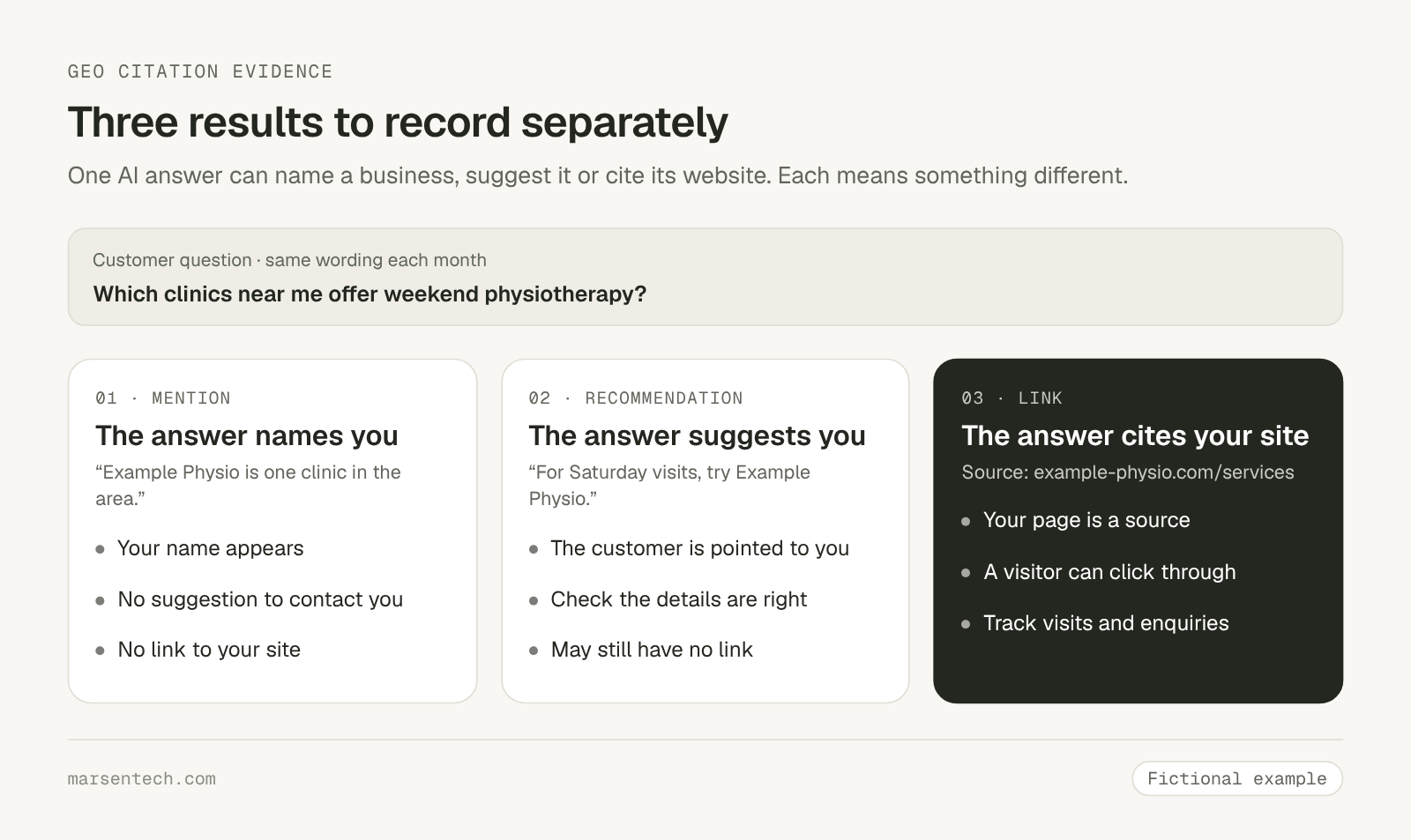
- Citation evidence: You'll see if an answer just mentions you, recommends you or links to your site. We keep those three separate.
- AI visibility monitoring: We ask the same questions every month. Then you can see how the sources and your enquiries change.
From a question to an enquiry
- 01AI crawler access
- 02Entity clarity
- 03Answer-ready content
- 04Citation evidence
- 05AI visibility monitoring
What does the research say works in GEO?
In the study that named GEO, adding sources, quotes and statistics worked best. It made pages 30 to 40% more visible in AI answers. Keyword stuffing barely helped.
Here's what the researchers tested, from the GEO paper on arXiv:
| What they changed | What happened |
|---|---|
| Added sources, quotes and statistics | Pages became 30 to 40% more visible on the study's main score |
| Made the writing clearer and easier to read | Visibility improved by 15 to 30% |
| Added extra keywords | Little or no gain, and 10% worse than no change on Perplexity |
What worked also changed from one topic to the next. That's why we help you add proof you can stand behind, instead of repeating keywords. We never add a statistic to your pages that you can't back up.
How do we check what AI answers say about you?
We start with a set of customer questions. For each answer, we record the AI tool, the date, the exact wording and the sources.
We keep three results separate, because they mean different things for your business:
- A mention: The answer names your business.
- A recommendation: The answer suggests that the customer contact you.
- A link: The answer cites a page on your website as a source.
One answer on its own isn't a ranking, because answers can change from one run to the next. So we look for patterns across the whole set of questions.
Our AI visibility audit guide shows you how to set your own baseline. It keeps crawl access, indexing, page quality and answer checks apart. Our free observation worksheet gives you a place to log each answer.
How do our GEO services work?
Our GEO services start with what AI answers say today. Then we agree the scope, make your business easier to verify and repeat the same checks.
- Look at what happens today. Show us your website, the customers you want and the questions they ask. Any answers you've already saved help us set the baseline.
- Set the baseline. We check crawl access, indexing, page quality and answers separately. That way, the proposal names the pages and checks it will improve.
- Agree the scope. The scope names the AI tools, the questions, the pages and how often we review them.
- Make your business easier to verify. We fix service descriptions that aren't clear, company details that don't match and claims you can't back up.
- Repeat the same checks. We ask the same questions again later, and we look at which sources changed and whether you got more enquiries.
Can a GEO agency guarantee AI citations?
No. Nothing you add to your site can force an AI tool to include you, whether it's schema, a special file or a writing style.
Google's page on AI features and your website says there are no extra requirements. A page just needs to be indexed and able to show a snippet. A single citation also doesn't prove that one edit caused it. So we look for patterns across the same questions over time, and we track enquiries as well as mentions.
How much do generative engine optimization services cost?
The cost of GEO services depends on how many AI tools, questions and pages we check for you. How often we review them matters too.
We quote after we've looked at your site. These things also change the price:
- Site size, markets and page types
- Technical access and research depth
- How much content needs to be written
- Your reporting sources and how often we review
Rankings, AI citations and mentions on other websites aren't guaranteed. Paid ads, new platforms and ongoing content writing aren't included unless your proposal lists them.
How do you choose a generative engine optimization agency?
Choose a generative engine optimization agency that lets you see the real answers it checked. It should also build on evidence your team can prove.
Before you compare GEO agency proposals, ask these questions:
- Will I see the full answers? Each check should show the AI tool, the date, the question and the sources.
- Do you separate mentions, recommendations and links? They mean different things, so a report shouldn't add them together.
- Where will new claims come from? Every claim on your pages should be something your team can back up.
- How will we measure results? Look for the same questions checked over time, plus your enquiries.
- What's guaranteed? The honest answer is the work, not a citation.
A generative engine optimization company that promises a place in ChatGPT's answers is promising something it doesn't control.
What else do business owners ask about GEO?
Here are short answers to other questions you might have.
Is GEO different from SEO?
GEO is only a little different, because it still runs on SEO basics like crawling and indexing. That's why our technical SEO services are often the first step.
Is GEO the same as AI SEO?
They overlap, but they're not quite the same. Our GEO services focus on AI answers. Our AI SEO services cover both search results and AI answers in one plan.
Do we need an llms.txt file?
Not for Google, which says its search ignores AI text files like llms.txt. Other AI tools may read one, and our LLM SEO guide explains when it might help.
Which AI tools do you check?
We agree that in the scope, along with the questions and pages. We start with the AI tools your customers are most likely to use.
How often should we check AI answers?
It's worth checking once a month with the same questions. Check more often around launches or big changes to your website.
Can we do GEO ourselves?
Yes, you can start on your own. Use our AI visibility audit guide to set a baseline, then log each answer in the free worksheet. We can help when you want someone to fix the pages and repeat the checks with you.
What should we prepare before a GEO review?
Bring your website, the customers you want to reach and the questions they ask. If you've saved any AI answers, bring those too, along with examples of your work you're happy for us to use.
Who wrote this page?
Aranyak Sengupta is a co-founder of Marsen Technologies, an AI automation company in Siliguri, India. He works on technical SEO, structured data and AI search visibility. He also wrote our complete GEO guide and ran the public audit in it. This page was last reviewed on 22 Nov 2026.
What should you read next?
Read these pages next to plan your GEO work.
Clear from
the first conversation.
We agree the work, the cost, and how we’ll check progress together.
Look at what happens today
Show us your pages, tools, or process. We’ll explain what we find and where we can help.
Talk it through 02Make the agreed changes
We build and test with your team, keeping you involved in the decisions that affect your business.
Talk it through 03Check whether it helped
Review the results, ask questions, and decide what to improve next.
Talk it through
A practical next step
Tell us what
you want to improve.
Talk to our team You don’t need a technical plan to start a conversation.