
A practical guide for your team
Speed to Lead: Meaning, Statistics and How to Improve It
What is speed to lead?
Speed to lead is the time between a new lead contacting your business and your team's first real response.
A lead might fill in a web form, send a message or call your number. The clock starts at that moment and stops when someone answers their question. We're Marsen Technologies, an AI automation agency that builds instant replies and follow-up on SMS, WhatsApp and email. Book a free 60-second enquiry audit to see how quickly your business responds today.
Why does speed to lead matter?
Speed to lead matters because a lead's interest fades quickly, and the first business to reply often wins the conversation.
People often contact several businesses at once. If you answer first, you can ask questions, share prices and book the next step before a competitor does. A slow reply also tells the lead how you might treat them as a customer.
What do speed to lead statistics show?
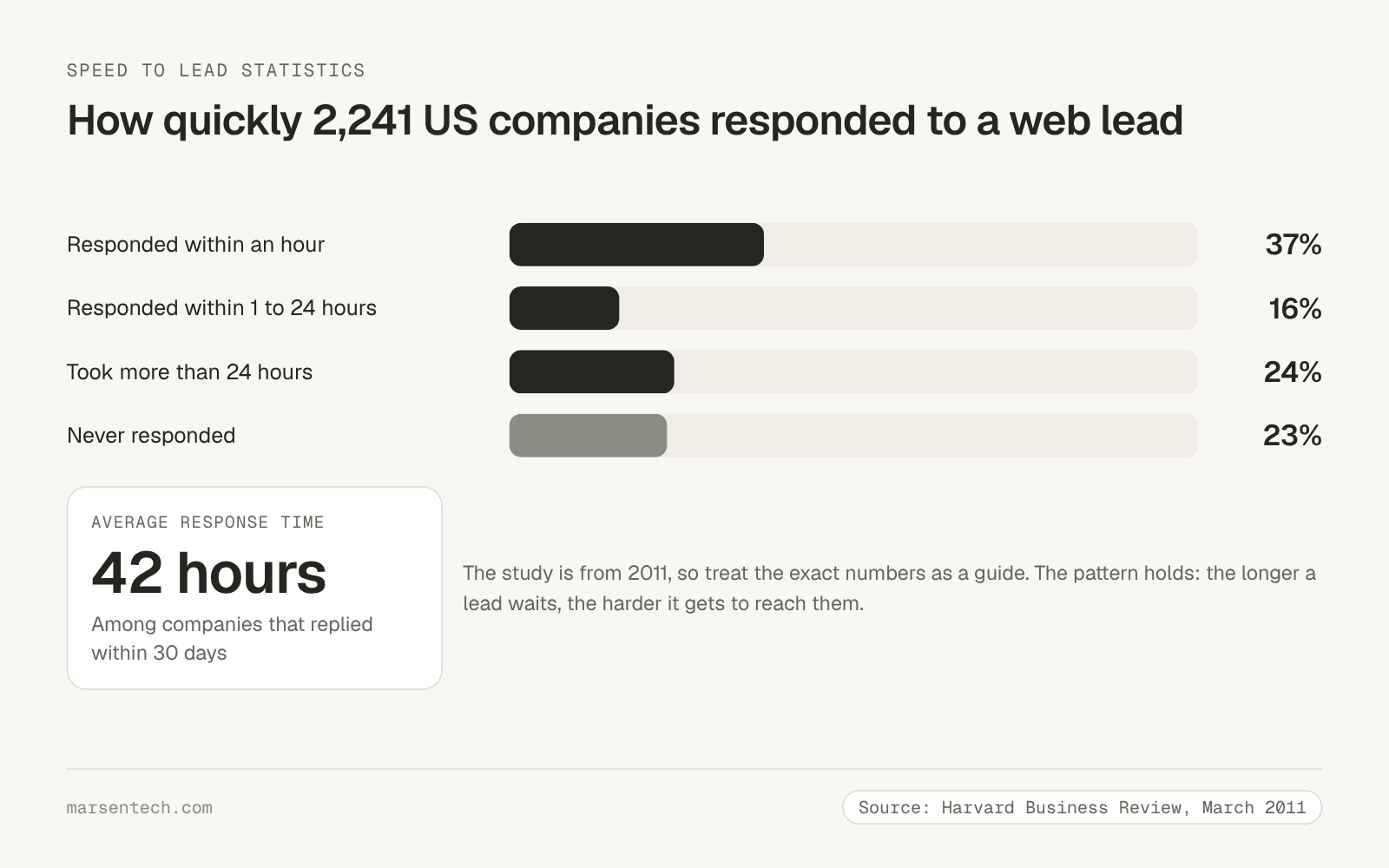
The best-known speed to lead statistics come from a Harvard Business Review study, and they show most companies reply far too slowly.
The study, The Short Life of Online Sales Leads, was published in March 2011. Researchers sent a web inquiry to 2,241 US companies and timed each reply.
Here's what they found:
| Finding | Result |
|---|---|
| Companies that responded within an hour | 37% |
| Companies that responded within 1 to 24 hours | 16% |
| Companies that took more than 24 hours | 24% |
| Companies that never responded | 23% |
| Average response time, among companies that replied within 30 days | 42 hours |
The same article also analyzed 1.25 million sales leads at 42 US companies. Some firms contacted a lead within an hour. They were nearly seven times as likely to qualify it as firms that made contact an hour later.
Compared with firms that waited 24 hours or longer, the fast firms were more than 60 times as likely. A lead counted as qualified when the firm actually talked with a key decision maker.
The study is from 2011, so treat the exact numbers as a guide. The pattern is clear: the longer a lead waits, the harder it gets to reach them.
What is a good lead response time?
A good lead response time is a few minutes during business hours, and never more than one hour.
The HBR research measured success within the first hour, so treat one hour as your upper limit. A common goal is five minutes, because the lead is probably still on their phone or your website. Choose a target your team can hit every time, then automate the first reply so nobody waits overnight.
How do you measure lead response time?
You measure lead response time by recording when each lead arrives and when your team first replies, then comparing the two.
Here's a simple way to start:
- Record the arrival time: Your form, phone system or inbox should save the exact time each lead comes in.
- Record both replies: Note when the automatic message went out and when a person first responded.
- Calculate the gap: Subtract the arrival time from the reply time for every lead.
- Check the median: One lead that waited a week can distort the average, so look at the median too.
- Split it by channel and hour: Compare web forms, calls and messages, and business hours with evenings.
- Review it weekly: Share the number with your team and look at the slowest replies first.
How do you improve speed to lead?
You improve speed to lead by replying automatically within seconds and routing every lead to the right person immediately.
These changes usually make the biggest difference:
- Instant first reply: Send an automatic text or email that confirms the request and asks one useful question.
- Smart routing: Assign each lead by location, service or availability, so nobody waits for a manager.
- Real-time alerts: Notify the assigned salesperson on their phone, not only in a shared inbox.
- After-hours coverage: Tell evening leads when you'll call, and offer a booking link they can use right away.
- Missed call text back: Text callers automatically when nobody answers, as our missed call text back guide explains.
- One clear next step: Offer a call, a booking link or a quote, rather than three options at once.
- Follow-up sequence: Send two or three polite reminders if the lead goes quiet after the first reply.
A fast reply only helps if it answers the question. A quick message without the price or the next step can still lose the lead.
What does speed to lead automation look like?
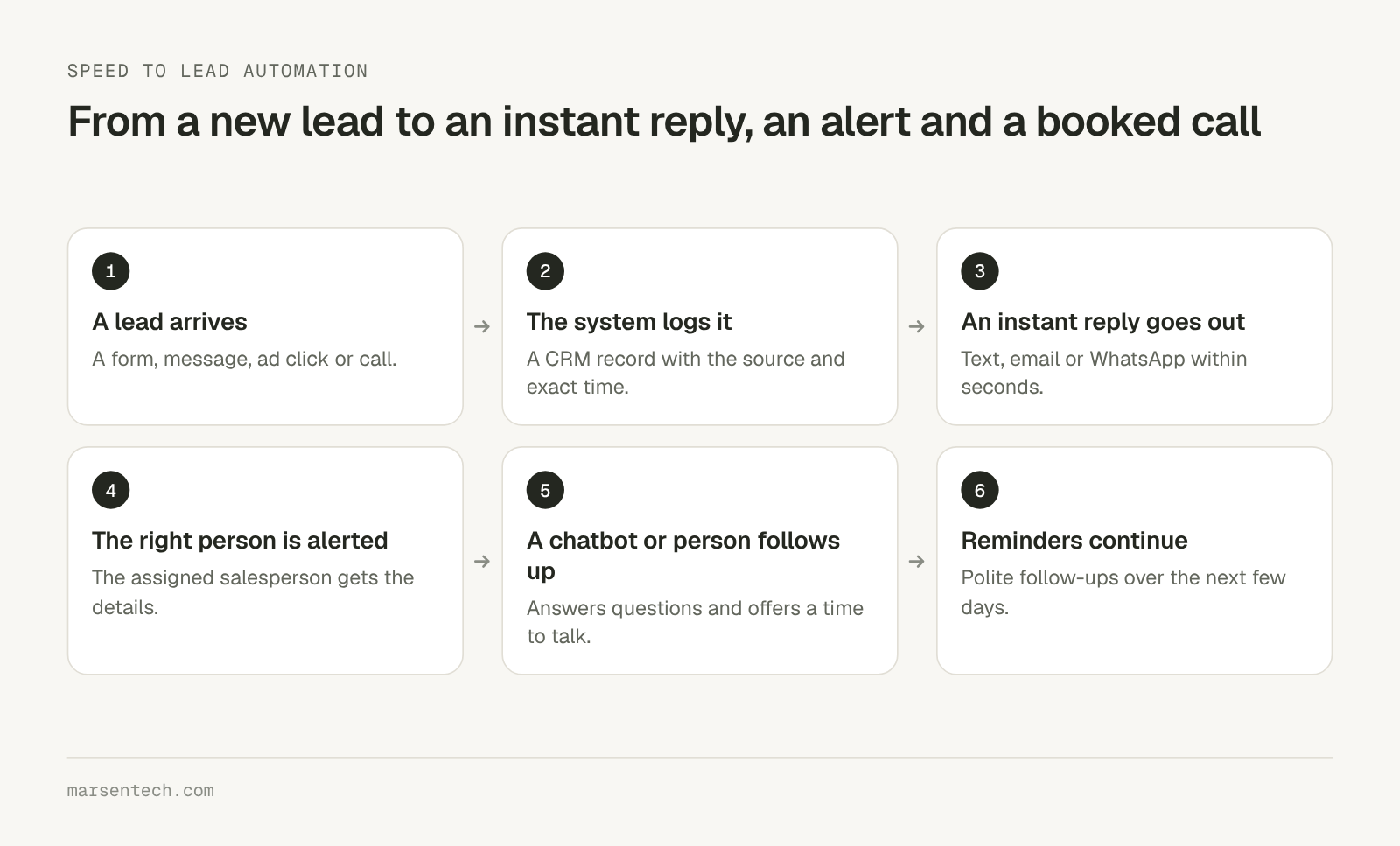
Speed to lead automation answers every new lead in seconds and alerts your team right away.
A typical setup works like this:
- A lead arrives: Someone submits a form, sends a message, clicks an ad or calls your number.
- The system logs it: Your CRM creates a contact record with the source and the exact time.
- An instant reply goes out: The lead receives a text, email or WhatsApp message within seconds.
- The right person is alerted: The assigned salesperson gets a notification with the lead's details.
- A chatbot or a person follows up: They answer questions, share prices and offer a time to talk.
- Reminders continue: If nobody books, the system sends polite follow-ups over the next few days.
How do you choose speed to lead software?
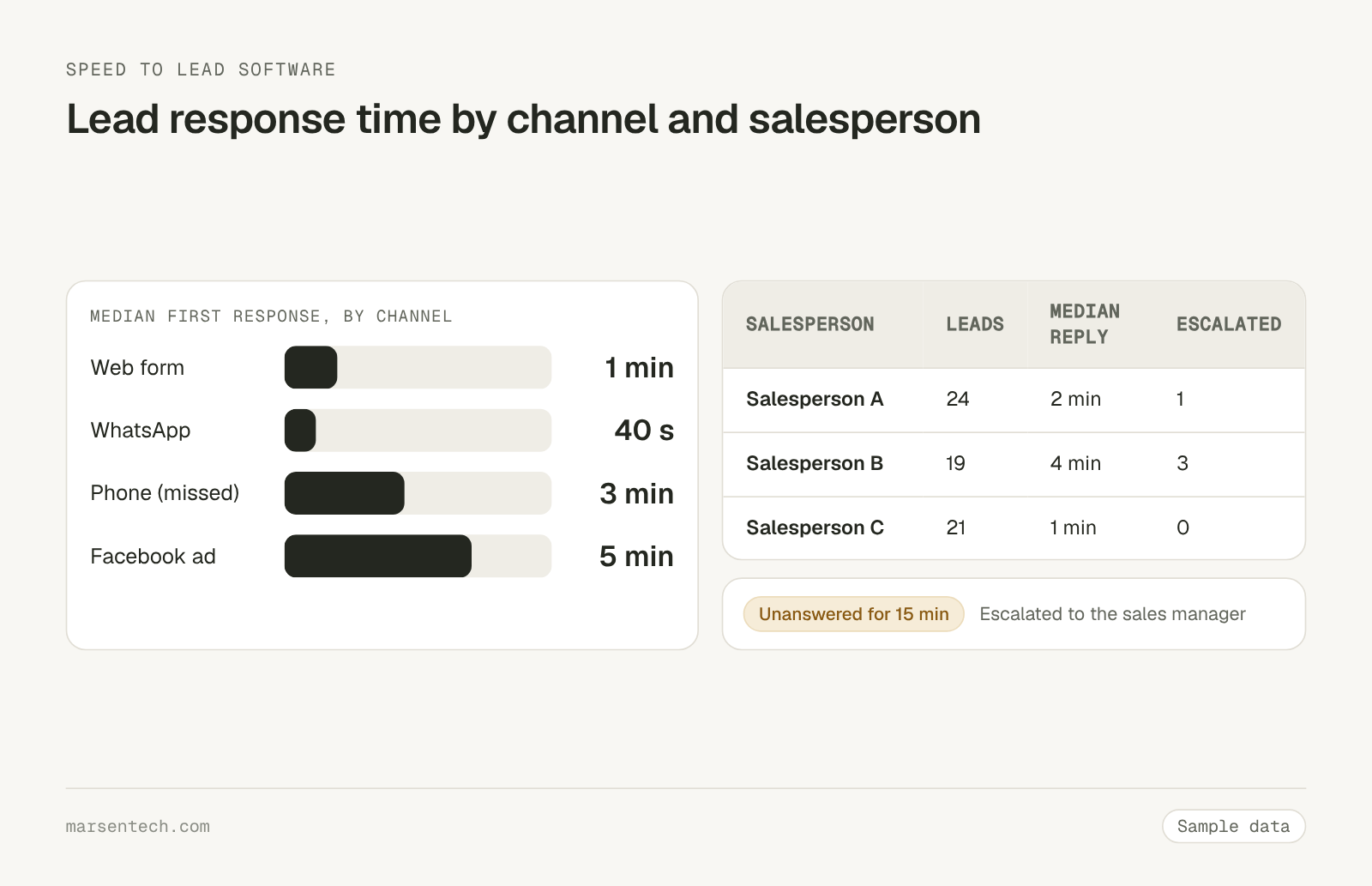
Choose speed to lead software that connects to every place your leads come from and replies within seconds.
Before you sign up, check that it:
- Captures leads from web forms, ads, calls, texts and chat in one place.
- Sends an instant reply by text, email or WhatsApp.
- Routes leads by territory, service or availability.
- Alerts salespeople on their phones and escalates unanswered leads.
- Logs every lead and reply in your CRM automatically.
- Reports response time by channel, salesperson and hour.
- Handles opt-outs and follows texting rules, such as A2P 10DLC registration in the US.
How does speed to lead work in real estate?
A good speed to lead real estate plan means replying to every buyer and seller inquiry within minutes.
A buyer who asks about a listing may contact several agents the same day. An instant text that confirms the property and offers a viewing time helps you start the conversation first. Agents who spend the day at showings can let automation send that first reply, then call back between appointments.
Can speed to lead work on WhatsApp?
Yes, where most customers use WhatsApp, the first reply can go out on WhatsApp instead of SMS or email.
That's common in India, where we build missed-call WhatsApp replies for coaching institutes and clinics. A lead who messages you first can get an automatic answer immediately. To message a lead who hasn't written to you yet, the WhatsApp Business Platform requires a Meta-approved template.
One service business we worked with went from 1 closed deal a month to 7 after adding AI follow-up. That's one result, not a promise.
Frequently asked questions
What is the speed to lead meaning in sales?
It means how quickly you respond to someone who just asked about your product or service. A faster reply gives you a better chance to talk to them.
Is five minutes a realistic lead response time?
Yes, for most small teams, if an automatic message sends the first reply. A person can then call back within the hour.
Does an automatic reply count as a response?
It counts as the first touch, but it isn't the whole job. Track the first automatic reply and the first reply from a person separately.
What about leads that arrive at night?
Send an instant reply that says when you'll call, and include a booking link. Then call those leads first thing the next morning.
Is speed to lead only for B2B sales?
No, it matters for any business that gets inquiries. Clinics, coaching institutes, home services and real estate teams all benefit.
Will replying quickly annoy new leads?
Usually not, because they just contacted you and expect an answer. Keep the first message short, include your business name and make opting out easy.
How is speed to lead different from lead nurturing?
Speed to lead covers the first response. Lead nurturing covers the messages that follow over days or weeks, until the lead is ready to buy.
Who wrote this guide?
Aranyak Sengupta is a co-founder of Marsen Technologies, an AI automation company in Siliguri, India. He builds instant lead replies, WhatsApp enquiry automation and CRM follow-up workflows. His focus is coaching institutes, clinics and other service businesses.
What should you read next?

Built around your business
Put these ideas to work in your business.
Book a demoShow us how your team works today. We’ll help you choose a useful first step.