A practical guide for your team
What Are AI Agents? Types, Examples and Business Uses
What are AI agents?
AI agents are software programs that work towards a goal on their own. You give an agent a task, and it decides the steps, uses tools like your calendar or CRM, and checks the result. It keeps going until the job is done or a person needs to step in.
A chatbot answers a question. An AI agent can answer it, book the meeting, update your records and send a reminder the following day.
We're Marsen Technologies, an AI automation agency in Siliguri, India. If you run a coaching institute, clinic or other service business, we can set up AI agents for you. This guide explains AI agents in plain language, with examples you can use in your own business.
What are agents in AI, in simple terms?
In computer science, an agent is anything that senses what's around it and acts to reach a goal. A thermostat is a very simple agent, because it reads the temperature and switches the heating on or off.
When people ask what are agents in AI today, they usually mean agents built on large language models. These are the same kind of models behind ChatGPT, Claude and Gemini.
You can talk to these agents in plain language, and they'll plan the steps and use other apps to get the task done. As Anthropic puts it, an agent is a model that directs its own process and tool use. That means you don't have to script every step.
How do AI agents work?
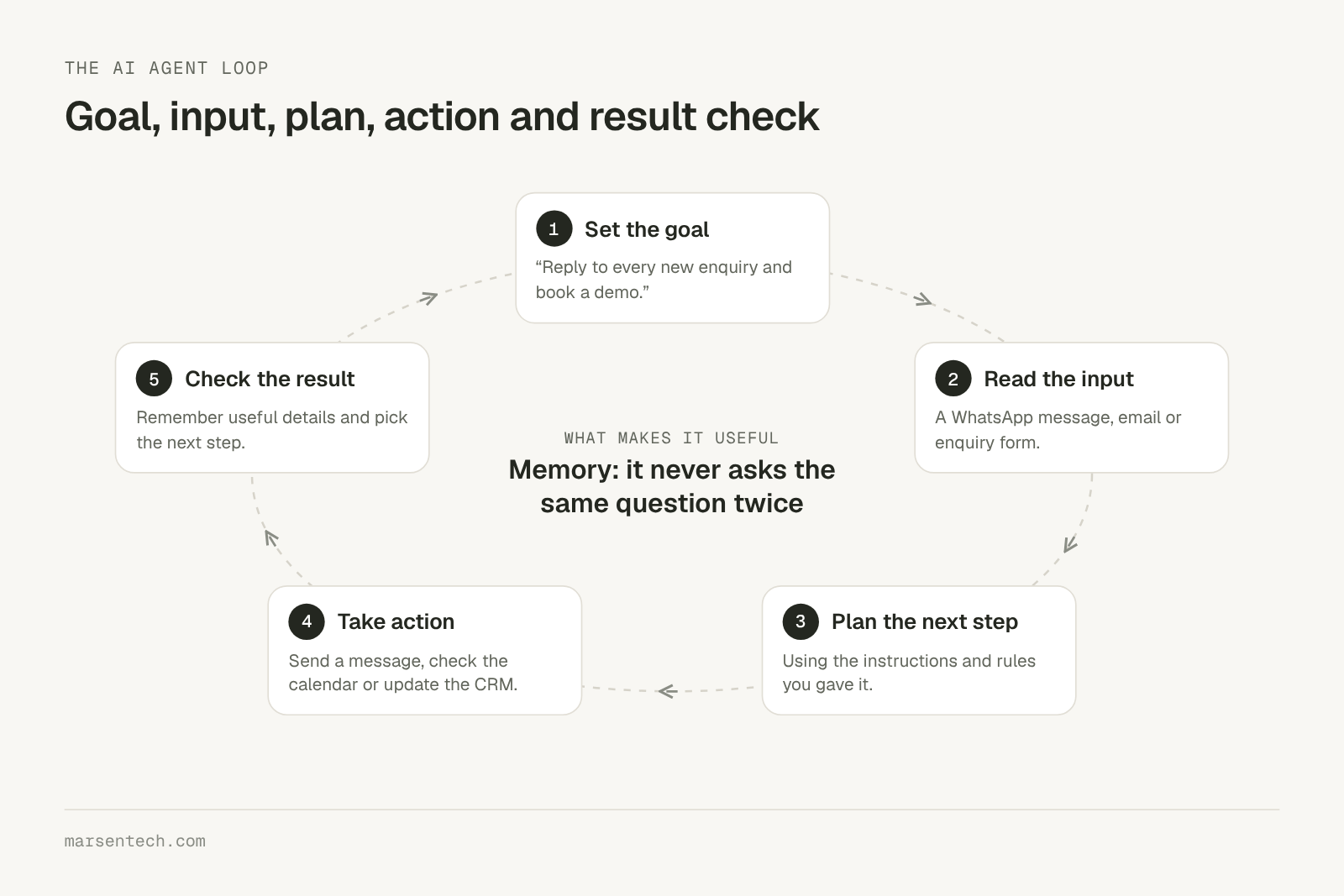
AI agents work in a continuous loop. They read the information in front of them, plan a step, act with a tool and then check the result. Most agents follow these five steps:
- Set the goal: You give the task, such as "reply to every new enquiry and book a demo".
- Read the input: The agent reads an incoming WhatsApp message, email or enquiry form.
- Plan the next step: It decides what to do, using the instructions and rules you gave it.
- Take action: It uses a tool, like sending a message, checking calendar availability or updating your CRM.
- Check the result: It looks at what happened, remembers useful details and picks the next step.
Memory is what makes this loop genuinely useful. A well-designed agent remembers everything the customer already mentioned, so it never repeats the same question.
How is an AI agent different from a chatbot or automation?
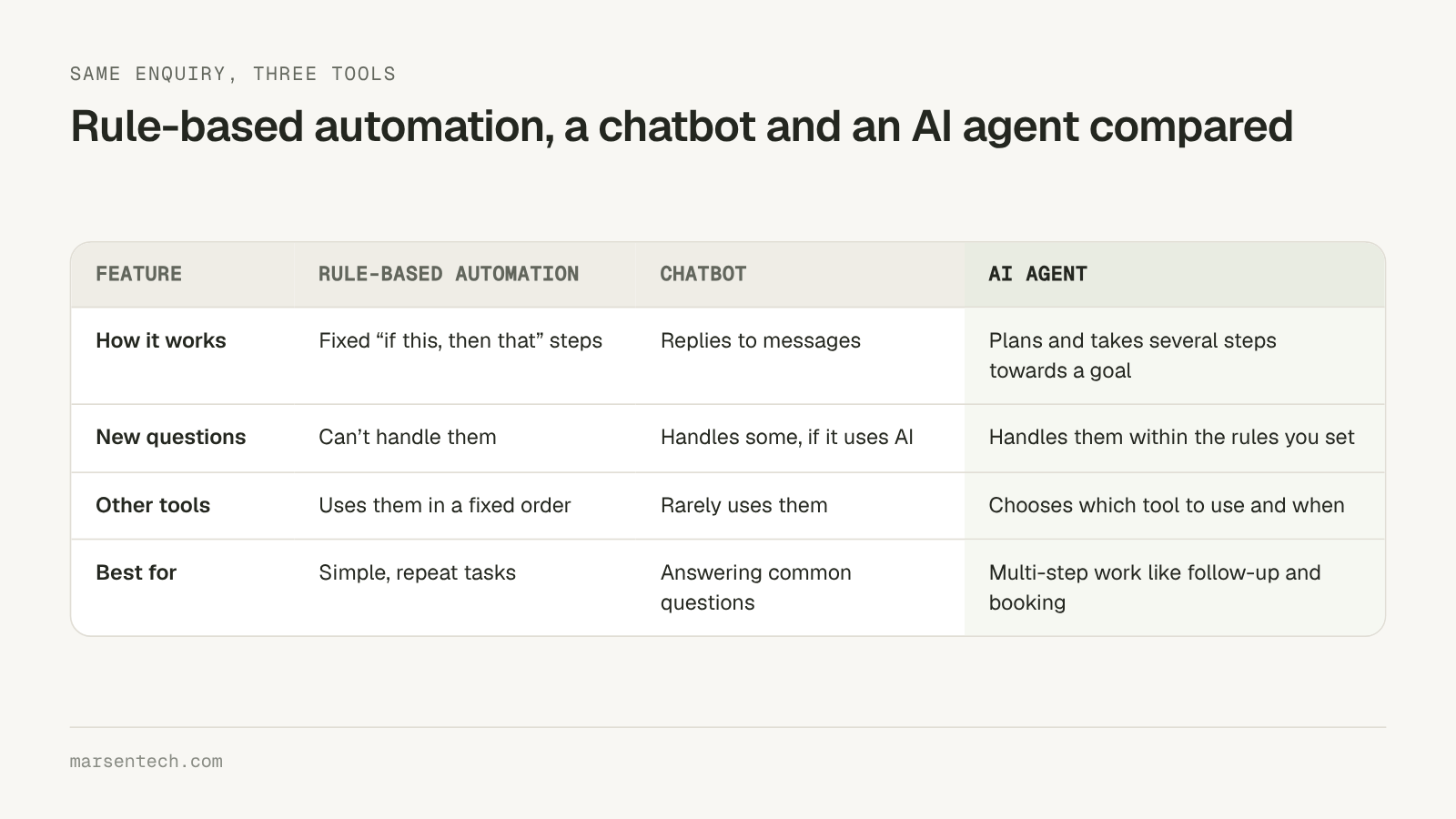
An AI agent plans and acts on its own, a chatbot mainly replies to messages, and rule-based automation follows fixed steps. Here's how the three compare:
| Feature | Rule-based automation | Chatbot | AI agent |
|---|---|---|---|
| How it works | Fixed "if this, then that" steps | Replies to messages | Plans and takes several steps towards a goal |
| New questions | Can't handle them | Handles some, if it uses AI | Handles them within the rules you set |
| Other tools | Uses them in a fixed order | Rarely uses them | Chooses which tool to use and when |
| Best for | Simple, repeat tasks | Answering common questions | Multi-step work like follow-up and booking |
Many businesses use all three of these together. The automation moves data, the chatbot talks to people, and the AI agent decides what should happen next. If a task never changes, simple automation is often the cheaper and safer choice.
What are the types of AI agents?
Textbooks usually list five types of AI agents, and IBM's guide to agent types uses the same groups. Each type can make smarter choices than the one before it.
What is a simple reflex agent?
A simple reflex agent follows fixed rules based only on what it sees right now. An auto-reply that sends your fee list whenever someone types "fees" works like a simple reflex agent.
What is a model-based reflex agent?
A model-based reflex agent keeps a simple picture of the world, so it can act even when it can't see everything. A robot vacuum that remembers which rooms it has already cleaned is a good example.
What is a goal-based agent?
A goal-based agent picks whatever action gets it closer to the goal you've set. A navigation app that calculates a route to your destination works this way.
What is a utility-based agent?
A utility-based agent compares options and picks the best one, not just one that works. A booking agent that finds the slot that suits both the parent and the teacher is utility-based.
What is a learning agent?
A learning agent improves over time using feedback. A support agent that gives better replies once your team corrects its mistakes is a learning agent.
You'll also see multi-agent systems in newer tools. In these, several specialised agents each handle one part of the work and pass results along.
What are some AI agents examples?
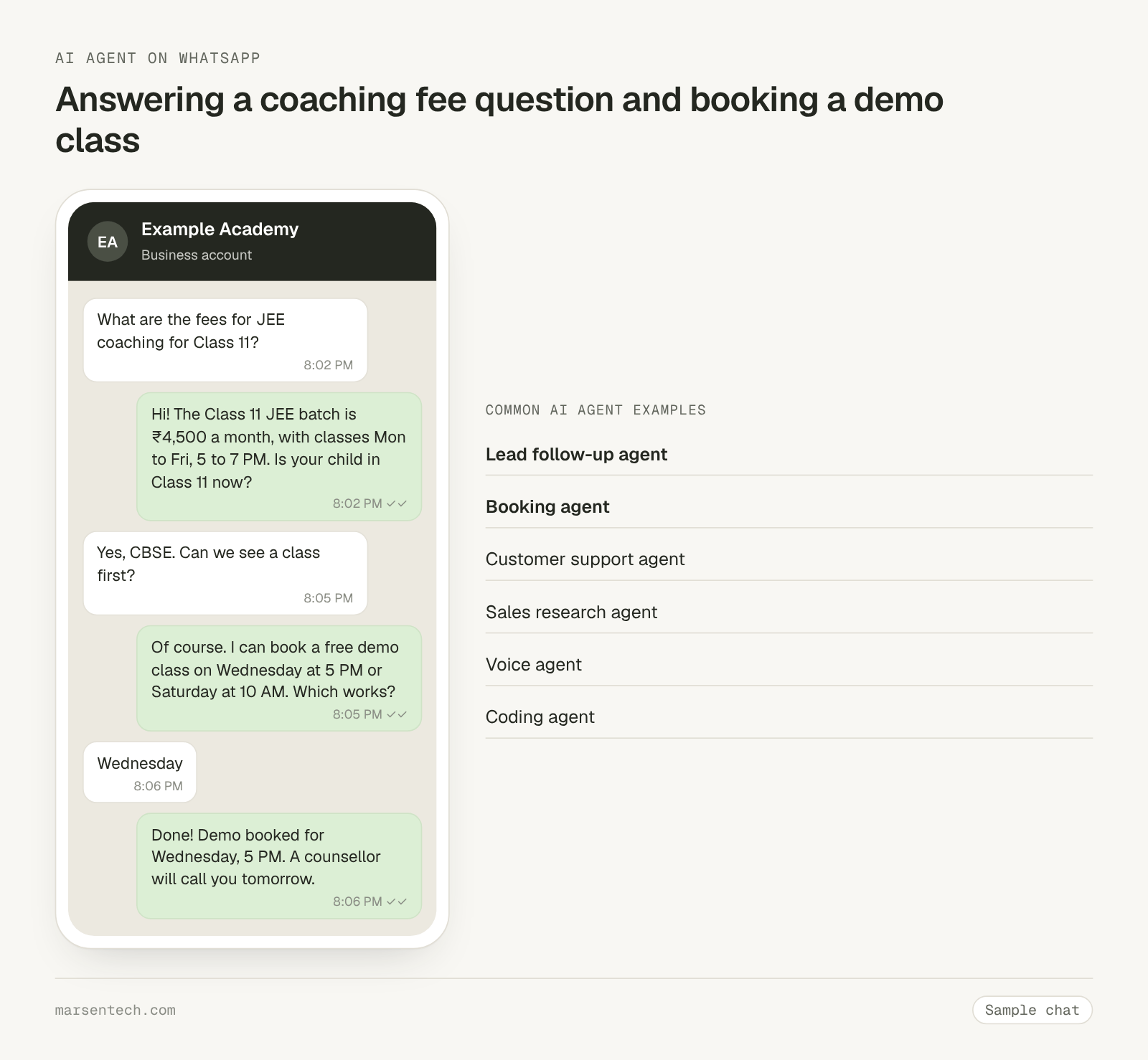
You'll see the most common AI agents examples in lead follow-up, appointment booking and customer support. Others handle sales research, voice calls and coding. Here's what each one does:
- Lead follow-up agent: Replies to new enquiries on WhatsApp within seconds, asks a few questions and offers a call slot.
- Booking agent: Checks availability in your calendar and confirms demos or appointments inside the conversation.
- Customer support agent: Answers your customers' everyday questions using approved information, then passes tricky cases to your team.
- Sales research agent: Reads a prospect's website and notes before a call, so your team walks in prepared.
- Voice agent: Answers incoming phone calls, takes detailed messages and schedules appointments by voice.
- Coding agent: Helps developers write, test and fix code inside their editor.
How do AI agents for business help your team?
AI agents for business work best on tasks that repeat every day, need a quick reply and follow clear rules. Here's where they help most:
- Faster replies: The agent responds at any time of day, so new enquiries don't wait until the next morning.
- No forgotten follow-ups: It sends reminders on schedule and stops as soon as the person replies.
- Cleaner records: It automatically saves every lead's details to your CRM, so nobody types them in manually.
- More time for people work: Your team spends less time on repetitive questions and more time on phone calls and visits.
One service business we worked with went from 1 closed deal a month to 7 after adding AI follow-up. That's one result, not a promise, and your numbers will depend on your leads and your offer.
What are the limits and risks of AI agents?
AI agents are useful, but they can still make mistakes that affect your customers. Plan for these limits before you launch one:
- They can make mistakes: An agent can misread a question, so keep it within information you've approved.
- They need clear rules: Tell the agent what it must never do, like promising discounts or giving medical advice.
- They need a human backup: Every conversation should offer an easy way to reach a real person.
- They need your data kept safe: Give your agent only the customer details it needs to do its job, and nothing more.
- They need regular reviews: Read the conversations every week and fix any weak replies.
If you want to go deeper, the NIST guidance on generative AI risks has a longer checklist you can use.
How can your business start with AI agents?
You don't need a complicated project to get started. Begin with one repetitive task that takes up too much of your team's time.
- Choose one task: For example, answering new enquiries or following up after a demonstration.
- Write down the rules: List the common questions, the approved answers and when a person should take over.
- Connect your tools: Connect the agent to WhatsApp, your booking calendar and your existing CRM.
- Test with real examples: Try everyday questions, unusual ones and a customer who asks you to stop messaging.
- Launch and review: Go live, read the conversations every week and improve the replies.
Want help choosing the first task? Book a free 60-second enquiry audit and we'll show you which jobs an AI agent could take off your team's plate. You can also see what we build on our AI agents page.
Frequently asked questions
What is an AI agent in simple words?
An AI agent is software that works towards a goal on its own. It reads information, decides what to do, uses tools to act and then checks the result.
Is ChatGPT an AI agent?
ChatGPT is mainly a chatbot that answers questions. It starts acting more like an agent when it can use tools, such as searching the web or completing tasks for you.
Are AI agents safe for business?
They're safe when you set clear limits, use approved information and protect customer data. You should also keep a person in charge of sensitive cases.
Will AI agents replace my employees?
AI agents take over repeat tasks, so your team has more time for work that needs judgement and a personal touch. They work best alongside people, not instead of them.
How much does an AI agent cost?
The cost depends on the tasks and the tools it connects to. At Marsen, AI agents are part of our Full AI Follow-Up System, and we'll suggest the right plan after a free audit.
Can AI agents work on WhatsApp?
Yes, an AI agent can run on the official WhatsApp Business Platform. It can reply to customers, book slots and update your CRM, as part of our WhatsApp automation setups.
Who wrote this guide?
Aranyak Sengupta is a co-founder of Marsen Technologies, an AI automation company in Siliguri, India. He builds AI agents, WhatsApp replies and CRM workflows for coaching institutes, clinics and other service businesses.
What should you read next?

Built around your business
Put these ideas to work in your business.
Book a demoShow us how your team works today. We’ll help you choose a useful first step.