
The Marsen glossary
Agentic AI: Definition, Meaning and How It Works
What is agentic AI in simple terms?
Agentic AI is AI that can set a goal, plan the steps and act on them with little human help.
Most AI tools you've used answer a question or write something when you ask. This kind of AI goes further. It decides what to do next, uses other software to do it and checks whether it worked.
Google Cloud's guide to agentic AI calls it an advanced form of AI focused on making decisions and taking action. Older AI mostly responds to commands or studies data. This newer kind can set goals, plan and carry out tasks with very little human input.
Google gives a simple example. Say the goal is to set up a meeting. The model reads the emails to find who should attend, when they're free and what it's about.
What does the term agentic AI mean for a business?
For a business, the agentic AI meaning is software that doesn't just write or answer, but takes action inside your systems.
The word comes from "agent," something that acts for you. It doesn't stop at drafting a reply for you to copy. It might also update the CRM record, book the follow-up and log what it did.
That's also why it needs more care. A wrong answer is easy to ignore. A wrong action, like a sent message or a changed booking, is harder to undo.
How does agentic AI work?
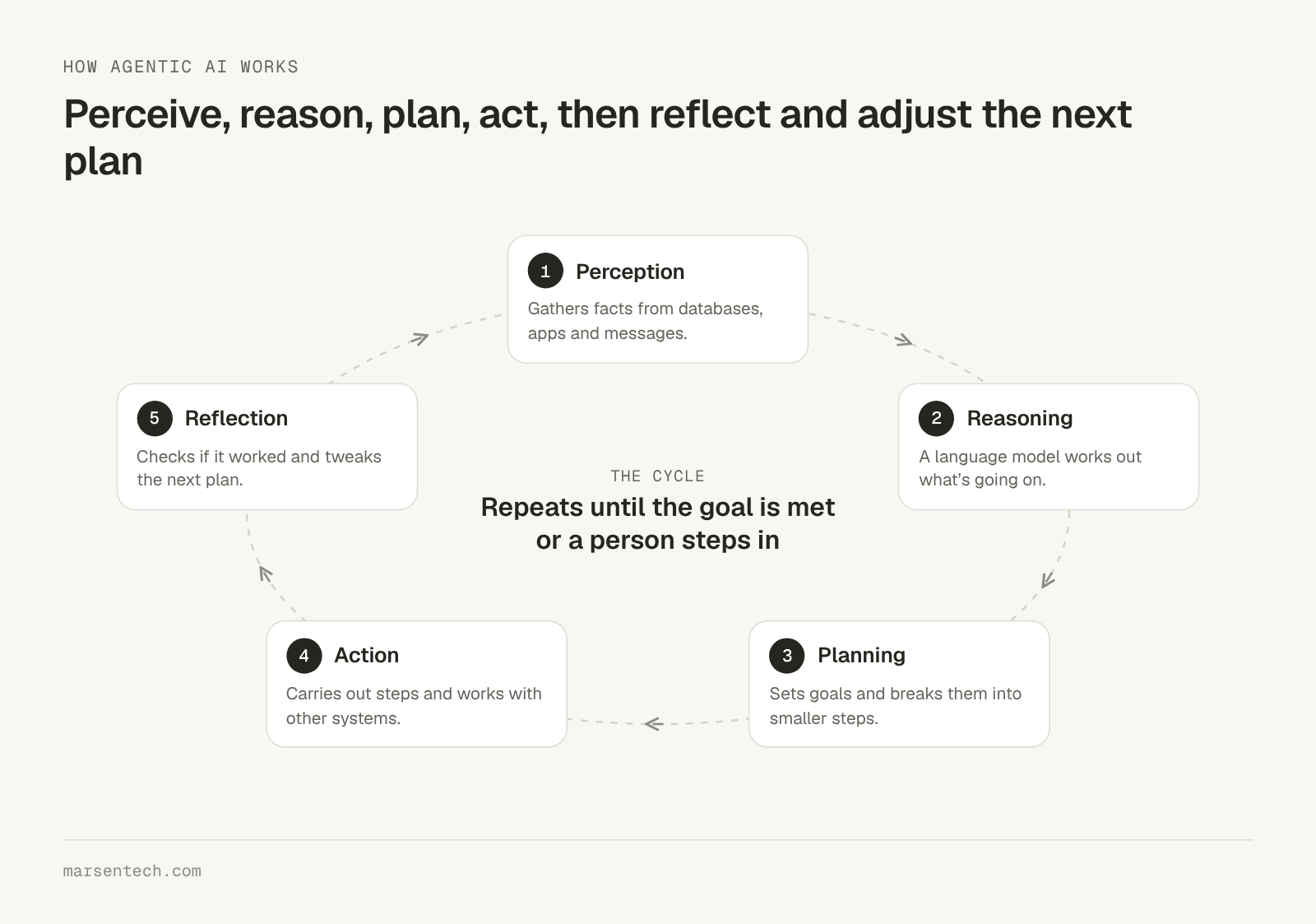
Agentic AI works in a cycle: it gathers information, thinks it through, makes a plan, acts and then learns from the result.
Google's guide breaks that cycle into five parts.
- Perception: it gathers facts from places like databases, apps and user messages.
- Reasoning: a large language model looks at those facts to understand what's going on and find possible answers.
- Planning: it sets goals and breaks them into smaller steps.
- Action: it carries out the steps, makes decisions or works with other systems.
- Reflection: it looks at whether the action worked and uses what it learned to tweak its next plan.
The cycle repeats until the goal is met or a person steps in.
The model in step two is the same kind of model behind chat tools. Our LLM entry explains how those models work.
How does agentic AI vs generative AI compare?
Generative AI makes content, while agentic AI uses that same kind of model to actually do things and reach a goal.
- Generative AI: writes text, images, code or music from a prompt. The value comes mostly from what the model produces.
- Agentic AI: uses a language model as its brain to act through tools and finish bigger goals.
Google describes agentic AI as a subset of generative AI. Its example is a marketing team. Generative AI could create the campaign materials. Agentic AI could then publish them, track how they perform and adjust the plan based on the results.
Think of a recipe and a cook. Generative AI writes the recipe. Agentic AI goes into the kitchen, checks what's in the fridge and starts cooking.
The two aren't rivals, because agentic AI often uses generative AI as one of its tools.
How is agentic AI different from an AI agent?
An AI agent is one building block, while agentic AI is the wider system that puts one or more agents to work.
Google compares agents to single tools in a toolbox. Agentic AI is the coordinated use of those tools to build a whole house. One agent might handle a single task, while the wider system manages several agents to reach a bigger goal.
Anthropic, the company that makes Claude, uses a related term. In its guide Building effective agents, it calls both fixed workflows and free-acting agents "agentic systems." Our AI agent entry explains single agents in more detail.
What are some agentic AI examples?
Common agentic AI examples show up in customer service, supply chains, health care, finance and software.
Google lists these uses across industries:
- Customer service: handling enquiries and fixing issues so human staff can focus on harder cases.
- Supply chains: reading sales, stock and shipping data to predict demand and plan deliveries.
- Health care: helping doctors and researchers go through patient records, papers and trial results.
- Finance: supporting fraud checks, risk reviews and investment research.
- Software: writing, fixing and testing code.
How could a coaching institute use agentic AI?
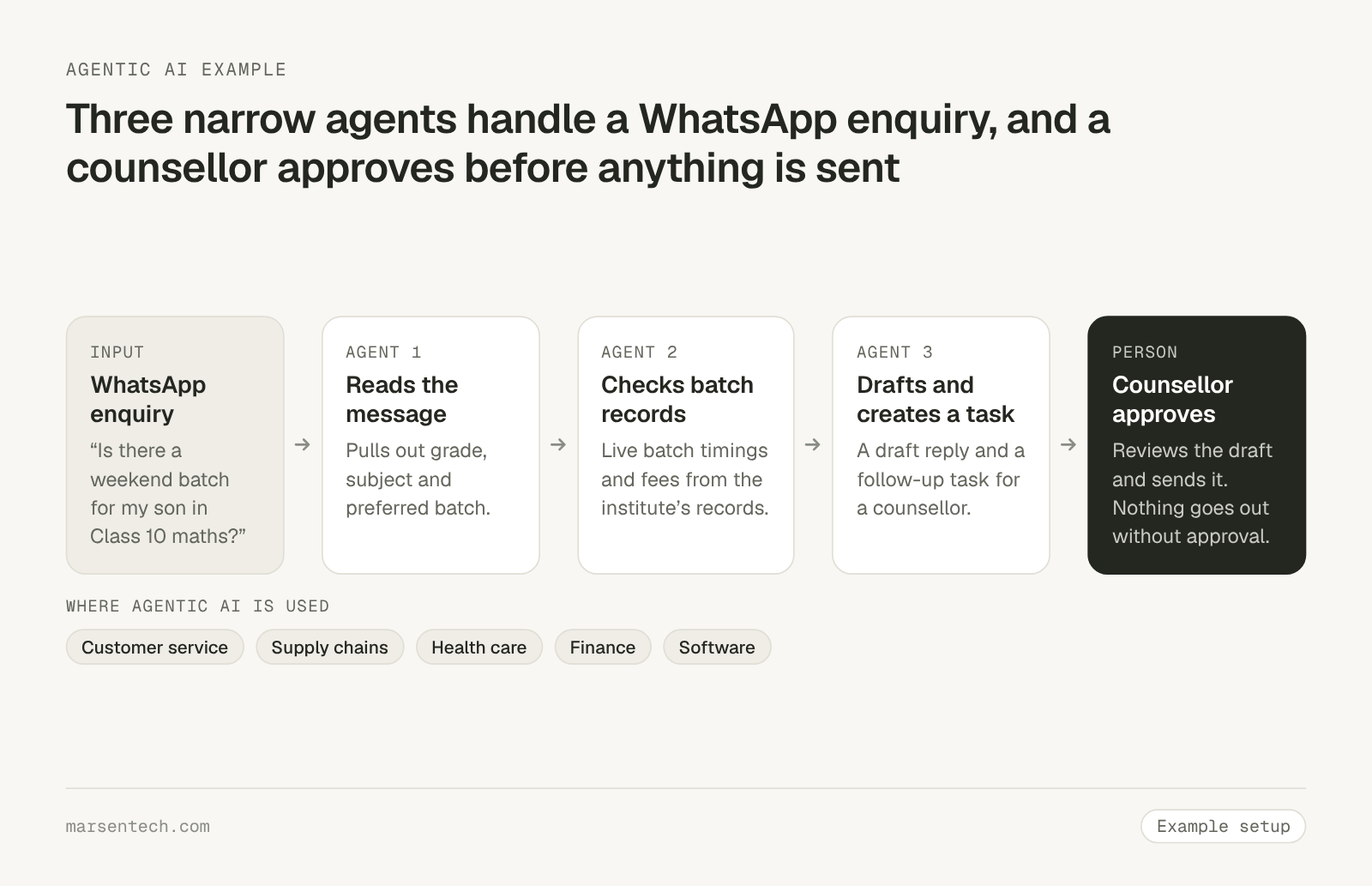
A coaching institute could run a small agentic AI setup behind its WhatsApp enquiries.
One agent reads each new message and pulls out the student's grade, subject and preferred batch. A second agent checks live batch timings and fees in the institute's records. A third creates a follow-up task for a counsellor and drafts a reply.
Each agent has one narrow job, which makes the whole setup easier to test. The counsellor reviews the draft and sends it. If the parent goes quiet, the system reminds the counsellor the next day. Nothing reaches the parent without a person's approval.
What does Gartner say about agentic AI?
Gartner expects over 40% of agentic AI projects to be canceled by the end of 2027.
In a June 2025 press release, it gave three reasons: costs that keep climbing, fuzzy business value and weak risk controls. Here are the other numbers it shared.
- Hype: only about 130 of the thousands of agentic AI vendors are real, by Gartner's estimate.
- Investment: Gartner polled 3,412 webinar attendees in January 2025. Of those, 19% said their company had invested heavily and 42% a little. Another 8% hadn't invested, and 31% were waiting or unsure.
- Decisions: at least 15% of day-to-day work decisions will be made by agentic AI by 2028, up from 0% in 2024.
- Software: 33% of business software apps will include agentic AI by 2028, up from less than 1% in 2024.
Gartner also warns about "agent washing." That's when sellers slap the agent label on chatbots or old tools that can't really act alone.
In short, the idea is real, but plenty of projects won't make it. Start small and measure the results.
What should you check before using agentic AI?
Check that the goal is clear, the data is clean and a person can review every important action.
Google suggests these best practices:
- Clear goals: know which problem the agents will solve and how it ties to your business goals.
- Good data: make sure records are accurate, complete and up to date.
- Fairness: watch for bias, and keep people in charge of decisions that affect others.
- Security: add guardrails, such as a sandbox, and protect customer data.
- Clear reasoning: pick systems that can show how they made a decision.
- Monitoring: track how the agents perform and fix problems as they come up.
We'd add one more. Hold any message to a customer until a person approves it. Our human approval guide shows how to set that up.
Do you need agentic AI, or is automation enough?
For most everyday tasks, plain automation works fine, and you only need agentic AI when the decisions keep changing.
Gartner puts it simply. Use agents when decisions are needed, automation for routine workflows and assistants for simple lookups. Anthropic gives similar advice: start with the simplest option and only add complexity when it clearly helps.
If every enquiry follows the same steps, workflow automation is cheaper and easier to trust.
Frequently asked questions
What is the agentic AI definition in one line?
Agentic AI is AI that can pursue a goal on its own by planning steps, using tools and checking the results.
Is agentic AI the same as AGI?
No, agentic AI gets tasks done, while AGI means AI that's as smart as a person at nearly anything.
What is agent washing?
Agent washing is when sellers put the agent label on chatbots or old tools that can't really act on their own.
Can agentic AI work without people?
It can run some steps alone, but Google says people should stay in charge, and anything sent to a customer needs a person's OK.
Is agentic AI safe to use?
It can be, as long as you limit what it can touch, try it in a sandbox first and keep a person signing off on big actions.
Does a small business need agentic AI?
Only if your work involves many decisions that change from case to case.
With a handful of fixed steps, a simple automation will do the job.
Who wrote this guide?
Aranyak Sengupta is a co-founder of Marsen Technologies, an AI automation company in Siliguri, India. He's the one who builds our n8n workflows, AI agents and approval steps. The Google Cloud, Anthropic and Gartner facts here come from their own pages, read on 22 November 2026.
What should you read next?

Built around your business
Put what you’ve learned to work.
Book a demoBring us your questions. We’ll help you find a useful next step for your business.