
Practical guides from Marsen
Follow Up WhatsApp Message: 25 Free Templates
What is a follow up WhatsApp message?
A follow up WhatsApp message is a short message you send when a customer hasn't replied to you.
It reminds the person about their original enquiry and offers one convenient way to continue. A good follow up message sounds helpful instead of pushy. You can send one after an enquiry, a quotation, a demonstration or an unpaid invoice.
Below are 25 free follow up WhatsApp message templates for enquiries, quotations, demonstrations, payments and customers who stopped responding. Replace the words in square brackets with your own details.
We're Marsen Technologies, an AI automation agency in Siliguri, India. We build WhatsApp lead follow-up for service businesses.
What should a follow up message include?
A follow up message needs four things: the customer's name, the context, something useful and one clear question.
Here's what to include in every part:
- Their name and yours: Start with the customer's name and your business name, so they recognise you immediately.
- The context: Mention what they enquired about and when, like "your enquiry about the weekend batch on Monday".
- Something useful: Add one helpful detail, such as the price, a brochure or an available appointment.
- One clear question: Finish with a single question they can answer in one word, like "Shall I reserve an appointment for Saturday?"
Which follow up WhatsApp message works after a new enquiry?
After a new enquiry, the best follow up WhatsApp message repeats what they asked for and gives them one next step.
Use these four examples during the first few days:
| When to send | Message |
|---|---|
| A few hours after the enquiry | Hi [customer name], this is [your name] from [business name]. You enquired about [service] earlier today. Would you prefer the complete price list or a quick telephone call? |
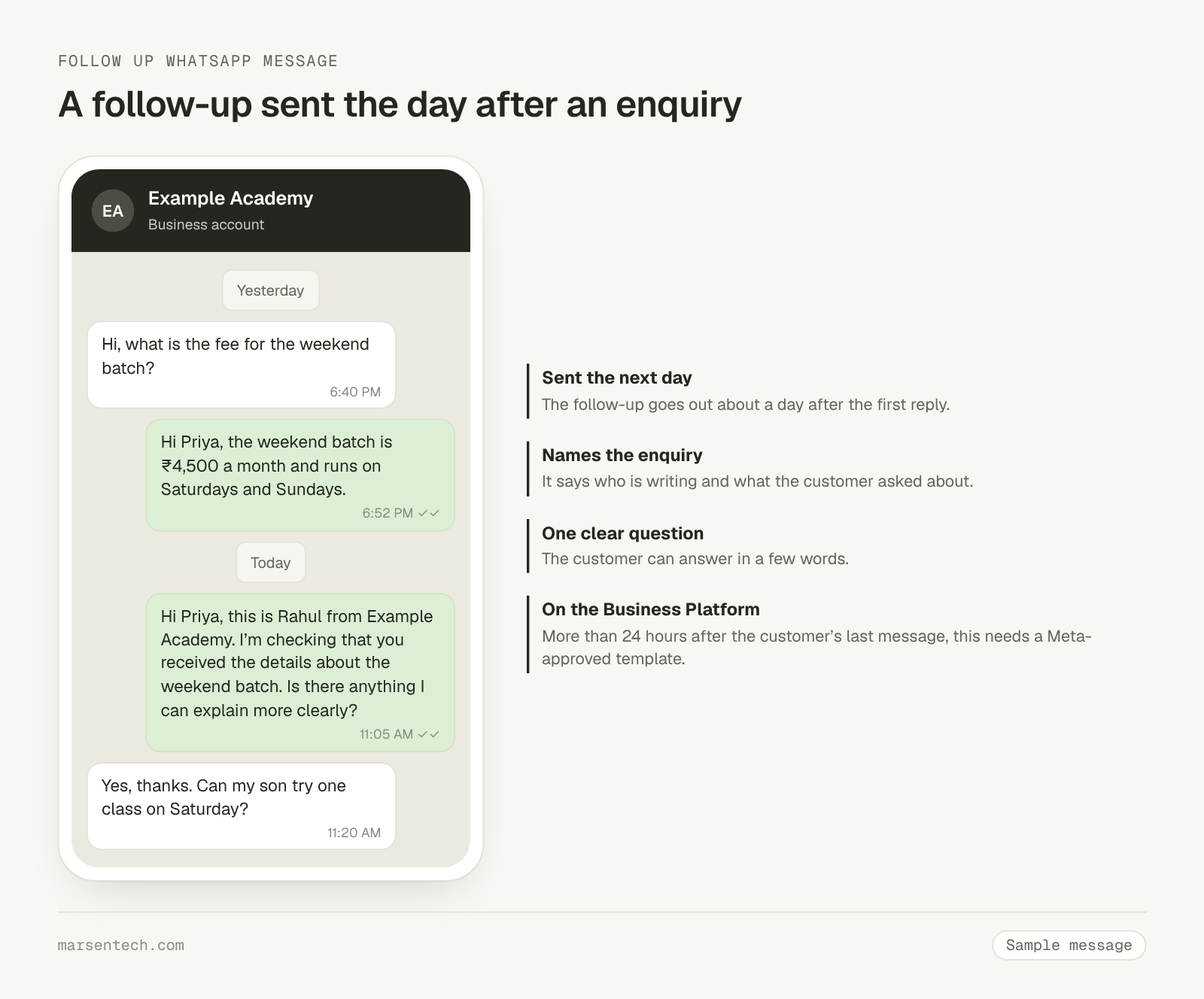
| The next day | Hi [customer name], I'm checking that you received the information about [service]. Is there anything I can explain more clearly? |
| When they asked for a price | Hi [customer name], the price for [service] is [amount], and it includes [what it covers]. Shall I reserve an appointment for you this week? |
| When you have a new answer | Hi [customer name], you asked whether [question]. The answer is [answer]. Would you like to continue, or do you need any other information first? |
What is a good sales follow up text message after a quotation?
A good sales follow up text message after a quotation confirms the customer received it and asks what is stopping them.
Send these four examples after you share a quotation or a proposal:
| When to send | Message |
|---|---|
| The day after the quotation | Hi [customer name], I sent the quotation for [service] yesterday. Did you receive it, and does it include everything you needed? |
| Three days later | Hi [customer name], have you had an opportunity to review the quotation? I'm happy to adjust the scope or explain any item. |
| When the price may be the problem | Hi [customer name], if the quotation is above your budget, please tell me the amount you have in mind. I will check what we can offer within that budget. |
| Before the quotation expires | Hi [customer name], the quotation for [service] is valid until [date]. Would you like me to reserve the same price for you? |
What should you send after a call, a meeting or a demo?
After a call, a meeting or a demo, you should send a short summary and the next step with a date.
These four examples keep the conversation moving:
| When to send | Message |
|---|---|
| Right after the call | Hi [customer name], thank you for your time today. As we discussed, I will send [document] by [day]. Please message me here if you have any other questions. |
| After a demo | Hi [customer name], thank you for attending the demonstration of [product or service]. Which part was most valuable for your team? |
| When you promised something | Hi [customer name], here is the [brochure, proposal or sample] I promised during our conversation. Please review it and share your opinion. |
| When they need time to think | Hi [customer name], you wanted some time to consider [service]. Is there any information that would make the decision easier? |
What are the best follow up text messages after no response?
The best follow up text messages after no response are short, polite and easy to answer with a single word.
Try these four when a customer stops responding:
| When to send | Message |
|---|---|
| After three days of silence | Hi [customer name], I don't want to disturb you, so I will keep this short. Are you still interested in [service]? A simple yes or no is perfectly fine. |
| After one week of silence | Hi [customer name], I understand that things get busy. Should I contact you again next week, or next month? |
| When the timing may be wrong | Hi [customer name], if this isn't the right time for [service], that is completely fine. When would be a more convenient time to talk? |
| When you have something new | Hi [customer name], we have just opened [new batch, appointment or offer] for [service]. You enquired about it earlier, so I thought of you. Would you like the complete details? |
What is a polite payment follow up message?
A polite payment follow up message mentions the amount, the due date and a convenient way to pay.
Use these three examples for invoices and outstanding payments:
| When to send | Message |
|---|---|
| Before the due date | Hi [customer name], this is a reminder that [amount] for [service] is due on [date]. You can pay here: [payment link]. Thank you. |
| On the due date | Hi [customer name], your payment of [amount] for [invoice number] is due today. If you've already paid, please ignore this message. |
| After the due date | Hi [customer name], we haven't received [amount] for [invoice number], which was due on [date]. Could you tell me when we can expect the payment? |
What should you send after a sale or a service?
After a sale or a service, you should send a thank-you message and ask for feedback a few days later.
These three examples help you build repeat business:
| When to send | Message |
|---|---|
| The same day | Hi [customer name], thank you for choosing [business name]. If anything isn't right with [product or service], message me here and I will resolve it. |
| A few days later | Hi [customer name], how is [product or service] working for you so far? Your honest feedback helps us improve our service. |
| When they are happy | Hi [customer name], we are delighted that you enjoyed it. Would you share a short review here? [Google review link] |
What should the last follow up message say?
The last follow up message should say that you will stop messaging and that the customer can still reply.
Send one of these three examples, then stop:
| When to send | Message |
|---|---|
| The closing message | Hi [customer name], I haven't heard from you, so I will close your enquiry for now. You can reply at any time and I will continue from there. |
| Offering a pause | Hi [customer name], this will be my final message about [service]. If you would like me to contact you again in a few months, reply "LATER". |
| Asking for a reason | Hi [customer name], I will stop following up after this message. If you chose another option, could you tell me why? It would really help us improve. |
When should you send each follow up message?
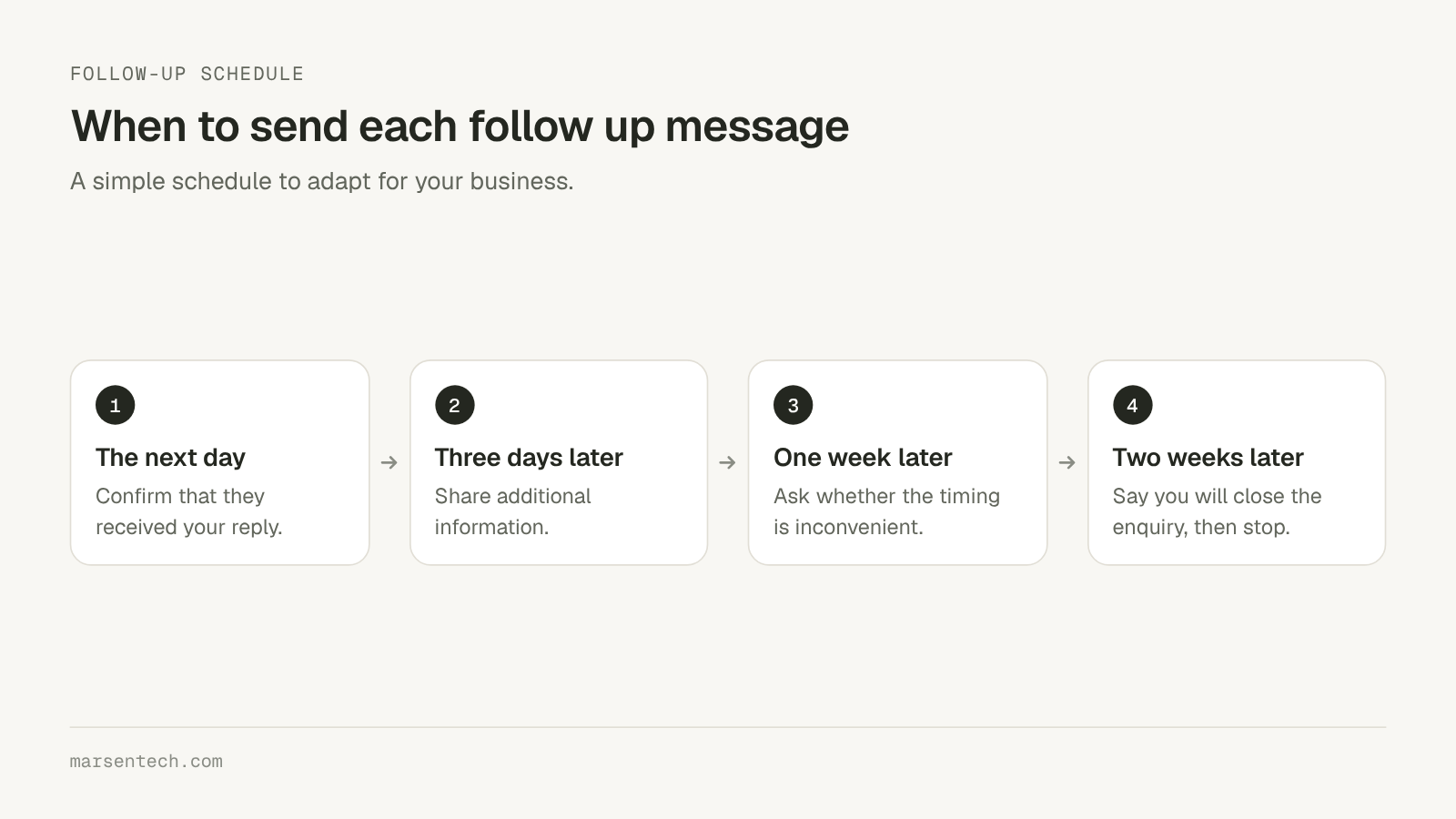
You should send the first follow up message within a day, then leave a longer gap before each new one.
Here's a simple schedule you can adapt for your business:
| Follow-up | When to send | What to say |
|---|---|---|
| First | The next day | Confirm that they received your reply |
| Second | Three days later | Share additional information |
| Third | One week later | Ask whether the timing is inconvenient |
| Last | Two weeks later | Say you will close the enquiry |
Adjust the intervals to suit your business. A clinic may follow up within hours, while a property consultant may wait longer between messages.
What are WhatsApp's rules for a follow up message?
WhatsApp's main rule is that you can only follow up with people who agreed to hear from you.
That rule comes from the WhatsApp Business Messaging Policy, which covers both the free app and the Business Platform. These are the important points:
- Opt-in: You may only message people who gave you their number and agreed to hear from you.
- Opt-out: If someone asks you to stop messaging them, you must stop.
- The 24-hour window: On the WhatsApp Business Platform, you can reply freely for 24 hours after a customer's last message.
- Templates: After those 24 hours, the Platform only lets you send message templates that Meta has approved.
- Reports: Customers can block or report your business, and WhatsApp may then limit how many messages you can send.
In the free WhatsApp Business app, you type and send every follow up message manually. Save the templates you use most frequently as quick replies, then type "/" in a conversation to select one.
What mistakes should you avoid in a follow up message?
The biggest mistake is sending the same "Any update?" message repeatedly without adding anything valuable.
Avoid these common mistakes too:
- No context: A message like "Hello, are you there?" forces the customer to scroll up and remember who you are.
- Too many questions: Ask only one question in every message, so it's easy to answer.
- Long paragraphs: Customers read WhatsApp on their mobile phones, so keep every message under five lines.
- Guilt or pressure: Sentences like "I have messaged you three times" make customers defensive.
- No end: Following up without stopping annoys customers, so send a closing message and stop.
When should you automate your follow up messages?
You should automate your follow up messages when your team forgets them or sends identical ones manually every day.
A follow-up workflow records every enquiry and gives it an owner. Then it sends the next approved message at the right time. That's what our WhatsApp lead follow up sprint sets up. Our guide to lead follow-up from your CRM explains the steps.
One service business we worked with went from 1 closed deal a month to 7 after adding AI follow-up. That's one result, not a promise. Book a free 60-second enquiry audit and we'll show you which follow-ups your business can automate first.
What else do business owners ask about follow up messages?
Here are short answers to the other questions you might have.
How many follow up messages should you send?
Three or four is a sensible number for most enquiries. Send a closing message after that, and only write again if the customer replies.
How long should you wait before following up?
Wait approximately one day after your first reply. Then allow a longer interval every time, such as three days, one week and two weeks.
Can you follow up with someone who never replied?
Yes, as long as they gave you their number and agreed to hear from you. On the WhatsApp Business Platform, you'll need an approved template once 24 hours have passed.
Are these templates free to use?
Yes. You can copy them, edit them and send them from the WhatsApp Business app without any cost.
Can you write a follow up message in Hindi or Bengali?
Yes. WhatsApp delivers the text exactly as you type it, in any language. You can also write to every customer in the language they originally used.
Do you need Meta's approval for these templates?
You only need it on the WhatsApp Business Platform, where Meta reviews every template before you can send it. In the free app, you can send any message you type.
Who wrote this page?
Aranyak Sengupta is a co-founder of Marsen Technologies, an AI automation company in Siliguri, India. He builds WhatsApp follow-up, CRM and lead capture workflows for service businesses. This page was last reviewed on 22 Nov 2026.
What should you read next?
Read these pages next to respond faster and organise your own follow-up process.

Built around your business
Put what you’ve learned to work.
Book a demoBring us your questions. We’ll help you find a useful next step for your business.