
Structured data
JSON-LD and Schema Markup Implementation Services
A schema generator gives you one block of code. Then a plugin adds another, and your theme adds a third. Now search engines see three different descriptions of your business. Meanwhile, the price in your markup still shows last year's number.
Our schema markup implementation services get JSON-LD into your templates, so each page tells Google what it is. We test it, remove markup that clashes and add a check that catches problems before they go live.
We're Marsen Technologies, based in Siliguri, India, and we work with teams remotely. Book a call and send us the site you'd like checked.
What is schema implementation?
Schema implementation just means adding Schema.org structured data to your templates, so each page tells Google what it's about.
Most sites use JSON-LD for this, a small block of code that search engines read. It describes the company behind the site, the service or product on the page, and each article's author. A generator makes one block for one page. Our work makes the markup right on every page and keeps it in line with what visitors see.
What do our schema markup services cover?
Every project starts with an audit of each page type. Most structured data problems are template problems, not page problems.
Here's what we check and build:
- An audit: What each page outputs today, plus copies, errors and anything that doesn't match the page.
- One shared identity: A single Organization and WebSite node, with the same @id values on every page.
- Page-type nodes: Service with offers, Article with a named author, Product, local business, BreadcrumbList and FAQPage.
- Markup from the page's own data: Prices and facts come from one source, so they can't drift apart.
- Validation: Each page type gets tested in Google's Rich Results Test and the Schema Markup Validator.
- Duplicate removal: We switch off extra markup from plugins or themes.
- A crawl check: The build fails if the JSON-LD on any page stops parsing.
We work in Astro, Next.js, WordPress and other platforms.
Which schema types do you implement?
We implement the Schema.org types that match what each page actually shows.
| Schema type | Where it's used | What it describes |
|---|---|---|
| Organization and WebSite | Every page | Who runs the site |
| Service with Offer | Service pages | What you sell and the price |
| Article with author | Guides and blog posts | Who wrote the page and when |
| Product | Product pages | The product and its details |
| Local business | Location pages | Your address, phone number and hours |
| BreadcrumbList | Inner pages | Where the page sits on the site |
| FAQPage | Pages with visible questions | The questions and answers on the page |
We only mark up facts your pages show. When a page shows no price, its markup leaves the price out.
Which pages should get schema first?
Start with the pages that earn money or build trust, because their markup does the most work.
Here's the order we usually suggest:
- Homepage and about page: One Organization node with your name, logo, address and profiles.
- Service and product pages: Service or Product nodes, with prices only where the page shows them.
- Guides and blog posts: Article nodes with a named author and real dates.
- Location pages: Local business nodes with the same address and hours as your Google Business Profile.
- FAQ sections: FAQPage markup only where the questions are visible on the page.
Fixing these templates first usually covers most of your site in a few changes.
What does schema implementation look like in practice?
Here's a real example from our own site, marsentech.com.
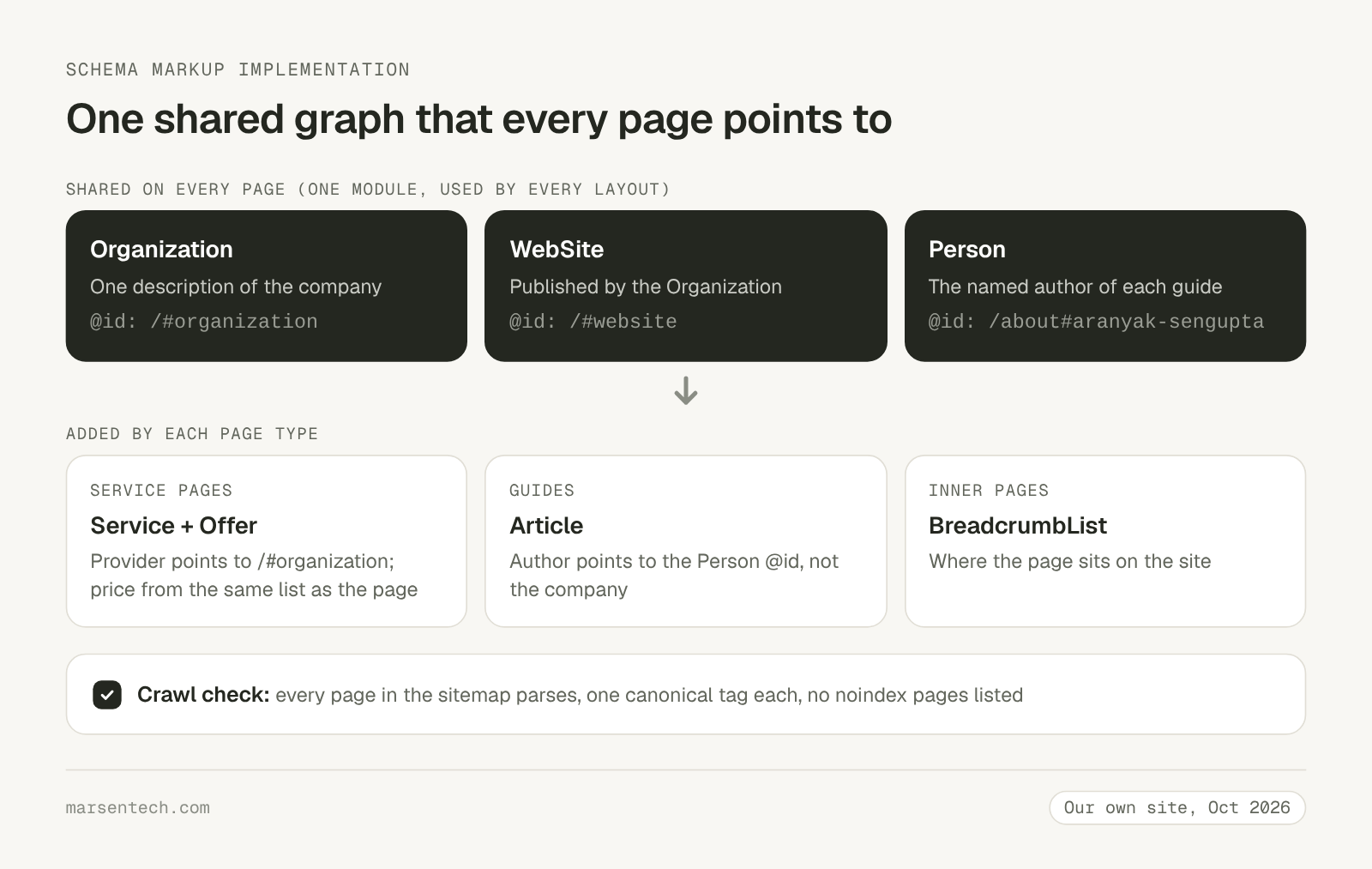
In October 2026, our site had two different descriptions of the company under the same @id. The homepage had a short one, and other pages had a longer one. Guides were credited to the company, not a person. And prices only appeared in the page text.
How did we fix it?
First, we moved our company and founder details into one shared file, and now every layout pulls from it. Each guide got an Article node whose author points to the founder's @id. Service nodes got Offer prices from the same price list as the page copy.
Then we crawled all 74 pages in the sitemap on our own machine. Every page's JSON-LD parsed, no page was set to noindex and each had one canonical tag.
| Before | After | |
|---|---|---|
| Organization | Two conflicting descriptions | One shared entity graph |
| Guide authors | The company | A named author on every guide |
| Prices | Only in the page text | Offers generated from the price list |
| Check | None | Every page's JSON-LD parses |
How do you implement schema markup across a whole site?
We'll implement schema markup in five steps, and you'll approve the plan before we touch any templates.
- Audit. We crawl your page types and list what each one outputs today.
- Design the graph. We plan the shared nodes, their @id values and the type for each page, and you approve it.
- Implement. We add the markup to your templates and connect it to the same data as the page.
- Validate. We test each page type and remove conflicting plugin or theme output.
- Add a check. A crawl check runs before each deploy, so broken markup doesn't reach your live site.
Can you add schema markup yourself first?
Yes. You can start with our free tools and bring the result to a review.
Our schema generator builds a JSON-LD block for a single page. Our JSON-LD implementation guide shows how to output one graph per page in an Astro layout without duplicates. New to the term? You'll find a plain-English explanation in our structured data glossary entry.
What can schema markup do, and where are its limits?
Valid structured data helps search engines and AI systems understand a page, but it doesn't guarantee results.
It can make some pages eligible for rich results. But it can't guarantee a rich result, a ranking or an AI citation. Markup that doesn't match the visible page can be ignored, or even lead to a manual action from Google. That's why we only mark up facts your pages actually show.
How much does a schema markup service cost?
We'll give you a price for schema markup implementation after a quick look at your site.
The price depends on these things:
- The number of page types
- Your platform, such as Astro, Next.js or WordPress
- Whether old plugin markup has to be removed
The quote lists the schema types and pages covered. Is your site on Astro, and does it need wider fixes? Our Astro SEO service covers canonicals, sitemaps and migrations too.
How do you choose a schema markup service?
Choose a schema markup service that works in your templates and only marks up what your pages show.
Ask these questions before you sign:
- Is the markup added to templates or page by page? Templates keep every page consistent.
- Where do the prices in the markup come from? They should come from the same data as the page.
- What happens to plugin schema? Conflicting output should be switched off, not left running.
- How will you test the markup? Look for validation and a crawl check before each deploy.
- Will you promise rich results? An honest answer is no, because Google decides.
What else do teams ask about schema implementation?
Here are short answers to other questions you might have.
Will schema markup get me rich results?
It can make pages eligible for some rich results, but Google decides whether to show them. The markup must match the visible page.
Do you work with WordPress and Next.js as well as Astro?
Yes. We use the same approach on every platform. You get one shared graph, markup from each page's own data, testing and no duplicates.
Does structured data help with AI search?
It makes facts and the links between them clear. That helps AI systems read a page the same way each time. It doesn't guarantee an AI citation. Clear content and proof from other sites matter more.
Can you remove schema added by a plugin?
Yes. We find which plugin or theme outputs each block, switch off what clashes and keep one graph.
Who wrote this page?
Aranyak Sengupta is a co-founder of Marsen Technologies, an AI automation company in Siliguri, India. He builds and tests our technical SEO work, n8n workflows and AI agents. He led the structured data fix on our own site described here. This page was last reviewed on 22 Nov 2026.
What should you read next?
Read these pages next to plan your schema markup.
Clear from
the first conversation.
We agree the work, the cost, and how we’ll check progress together.
Look at what happens today
Show us your pages, tools, or process. We’ll explain what we find and where we can help.
Talk it through 02Make the agreed changes
We build and test with your team, keeping you involved in the decisions that affect your business.
Talk it through 03Check whether it helped
Review the results, ask questions, and decide what to improve next.
Talk it through
A practical next step
Tell us what
you want to improve.
Book a call You don’t need a technical plan to start a conversation.