A practical guide for your team
AI Receptionist: How It Works, Use Cases and Setup
What is an AI receptionist?
An AI receptionist is software that answers your phone calls, books appointments and takes messages for you.
It greets callers in a natural voice, answers common questions and passes urgent calls to your team. Many also reply to texts and website chats. We're Marsen Technologies, an AI automation agency that builds receptionists and follow-up for service businesses. Book a free 60-second enquiry audit to see how many calls your business misses today.
How do AI receptionists work?
AI receptionists work by turning speech into text, picking a reply and saying it out loud in seconds.
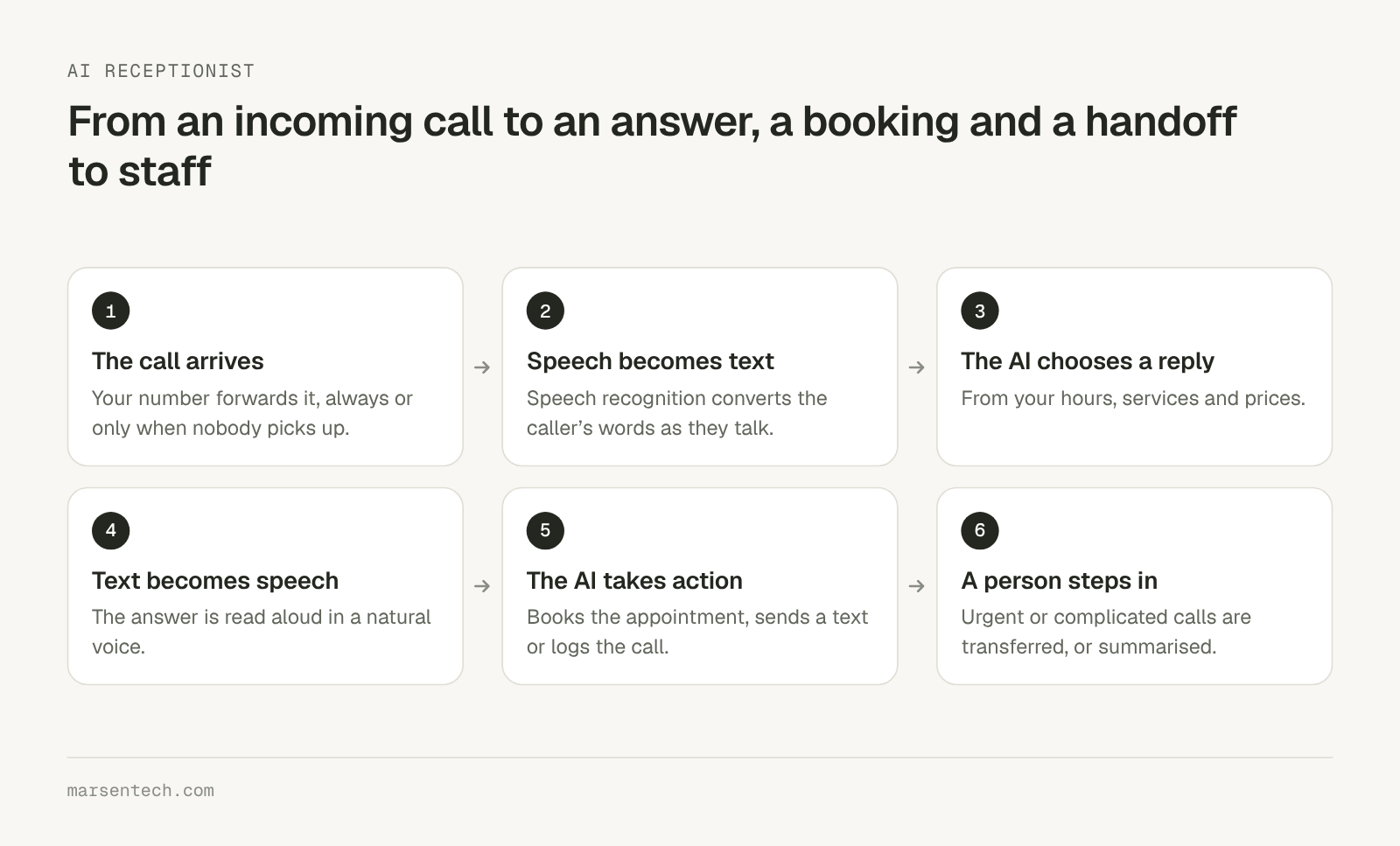
Here's what happens on a typical call:
- The call arrives: Your business number forwards the call to the AI, either always or only when nobody picks up.
- Speech becomes text: Speech recognition converts the caller's words into text as they talk.
- The AI chooses a reply: It answers from the details you gave it, like your hours, services and prices.
- Text becomes speech: The answer is read aloud in a natural voice, usually within a second or two.
- The AI takes action: It books the appointment, sends a text confirmation or logs the call in your CRM.
- A person steps in: Urgent or complicated calls are transferred, or the AI sends your team a summary.
What tasks can an AI receptionist handle?
An AI receptionist handles routine calls very well, but it still needs people for difficult or sensitive conversations.
Here's how it compares with a human receptionist:
| Task | AI receptionist | Human receptionist |
|---|---|---|
| Answering after hours | Every hour of every day | Only during working hours |
| Several calls at once | Answers them all together | One call at a time |
| Booking appointments | Books directly into a connected calendar | Books by hand |
| Common questions | Answers from the information you provide | Answers from experience |
| Upset or complicated callers | Should transfer them to a person | Handles them with judgment |
| Cost | A monthly fee, often plus usage charges | A salary and benefits |
What should an AI receptionist say when it answers?
An AI receptionist should greet callers by your business name, say it's a virtual assistant and ask how it can help.
Here are three short scripts you can adapt:
| Situation | What the AI receptionist says |
|---|---|
| Greeting | Thank you for calling [Business name]. I'm the virtual assistant, and I can book appointments or answer your questions. How can I help you today? |
| Booking | I have openings on [day] at [time] and at [time]. Which of those works better for you? |
| Handoff | I'll connect you with a member of our team now. If nobody answers, I'll take a message, and someone will call you back today. |
Is an AI receptionist for small business worth it?
Yes, an AI receptionist for small business is worth it if you often miss calls at busy times or after hours.
Small teams often can't answer the phone while they're with a customer. Every missed call is a potential customer who may phone a competitor instead. An AI phone receptionist answers immediately, collects the details and books the next step. You can estimate what your missed calls cost with our free missed call cost calculator.
What are the AI receptionist use cases by industry?
The main AI receptionist use cases by industry are booking appointments, answering repeat questions and capturing new leads.
How does an AI medical receptionist help clinics?
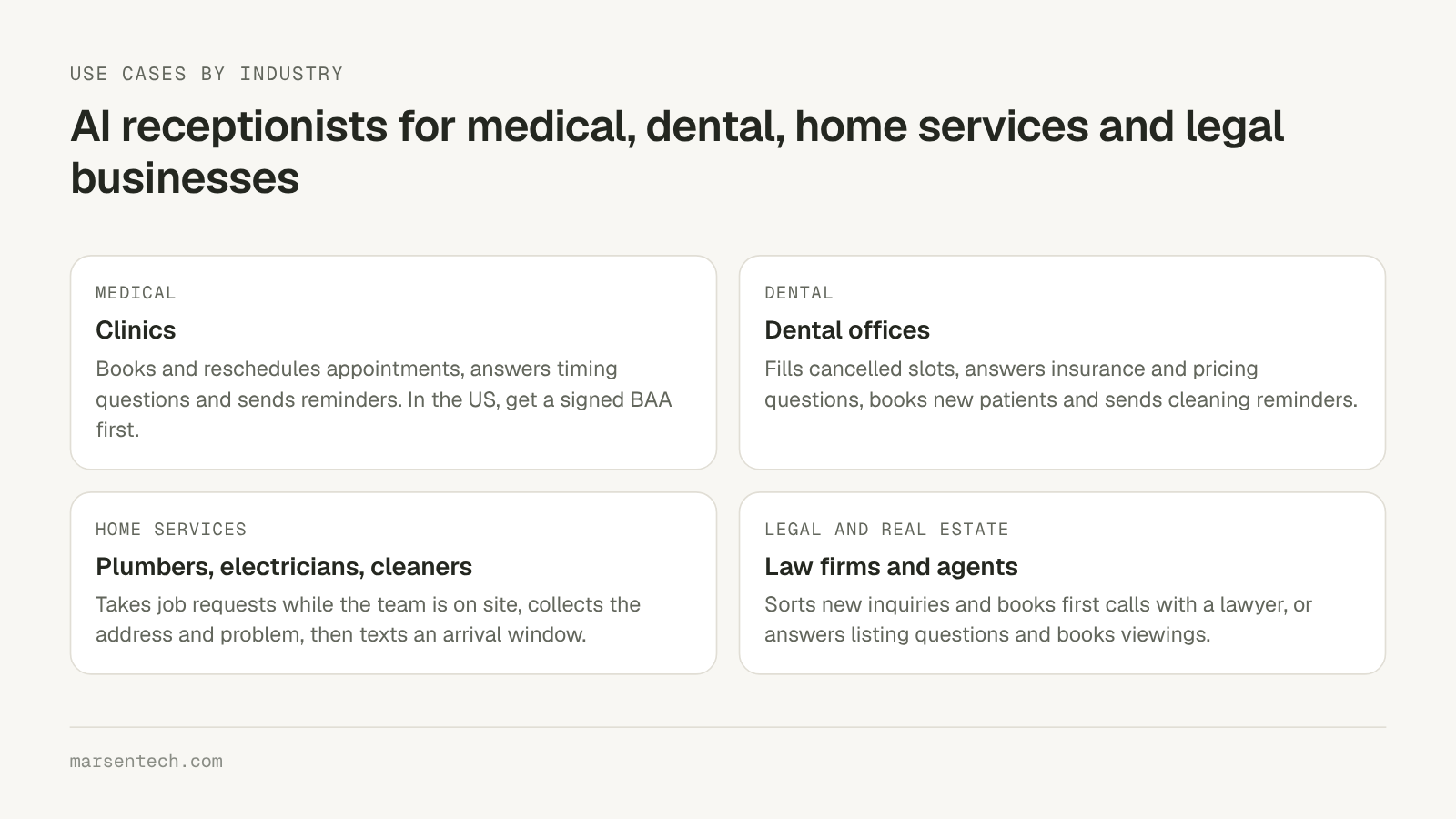
An AI medical receptionist books and reschedules appointments, answers questions about timings and sends reminders. In the US, get the vendor to sign a HIPAA contract called a BAA before patients start calling it.
How does an AI dental receptionist help dental offices?
An AI dental receptionist fills cancelled slots, answers insurance and pricing questions and books new patients. It can also remind patients when they're due for a cleaning.
How do home service businesses use AI receptionists?
Plumbers, electricians and cleaning companies use AI receptionists to take job requests while their teams are on site. The AI collects the address and problem, then texts back an arrival window.
How do law firms and real estate teams use them?
Law firms use them to sort new inquiries and book first calls with a lawyer. Real estate agents use them to answer listing questions and book viewings while they're out showing properties.
How do you choose AI receptionist software?
Choose AI receptionist software that sounds natural, connects to your calendar and hands difficult calls to a person quickly.
Before you sign up, check that it:
- Works with your existing business number, or lets you forward calls to it.
- Answers in a clear, natural voice that suits your brand.
- Learns your hours, services, prices and policies from a simple setup.
- Books directly into your calendar or scheduling system.
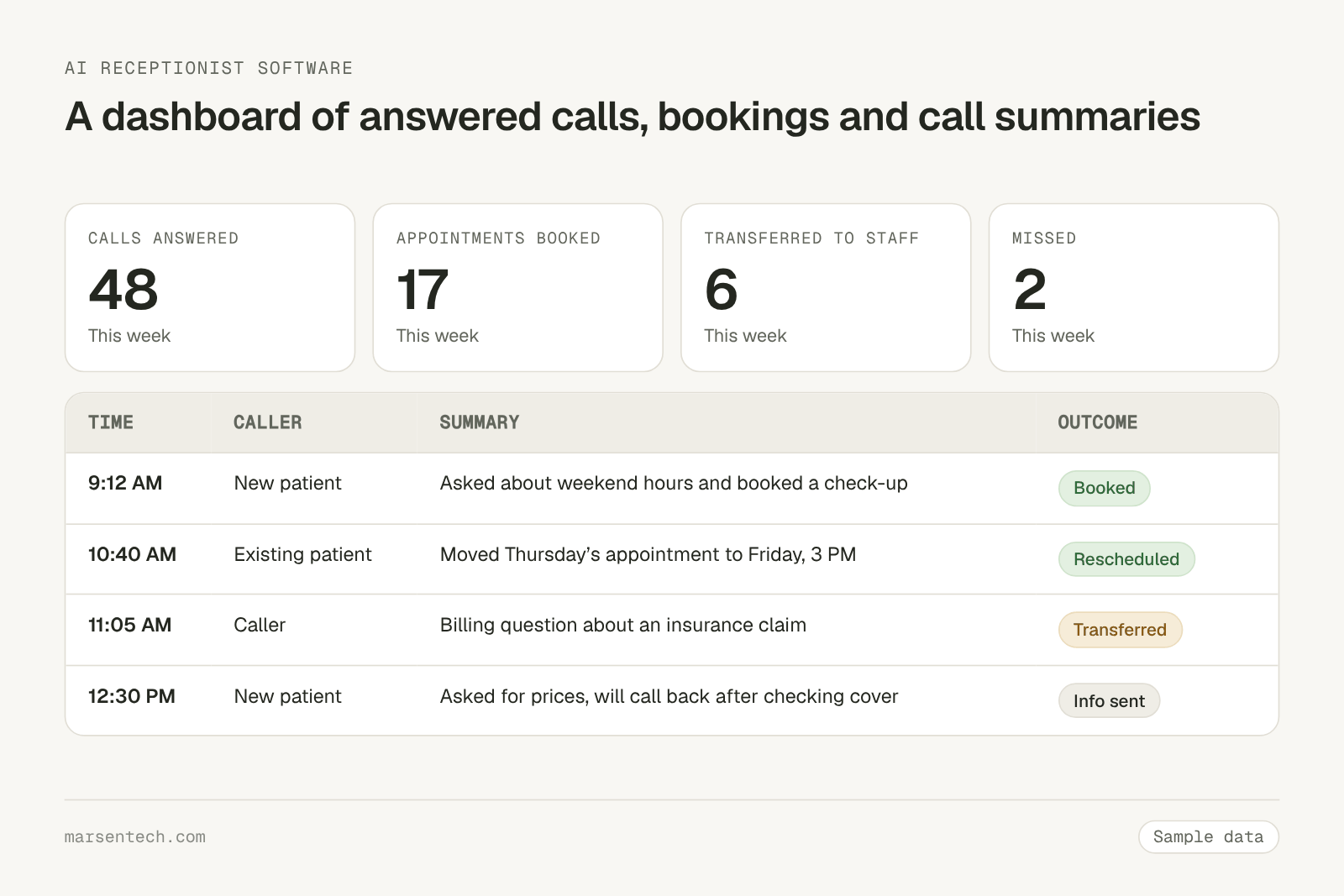
- Transfers urgent calls and sends call summaries to your team.
- Records transcripts and reports on calls answered, booked and missed.
- Keeps call data secure, and signs a BAA if you run a medical or dental practice.
What rules apply to AI receptionists in the US?
AI receptionists that answer incoming calls mostly need care with recordings, health information and outbound calls.
Keep these points in mind:
- Call recordings: Recording laws differ by state, so check whether you need every caller's permission before recording.
- Health information: HHS says covered entities generally need written contracts with business associates that handle protected health information.
- Outbound calls: In 2024, the FCC ruled that calls made with AI-generated voices count as "artificial" under the Telephone Consumer Protection Act.
- Honesty with callers: Tell people they're speaking with an AI assistant, and always offer a real person.
Your provider and your lawyer can confirm exactly what applies to your business.
How do you set up an AI receptionist?
You set up an AI receptionist by giving it your business details, connecting your tools and testing real calls.
Here's the usual order:
- Write down your answers: List your hours, services, prices, location and the questions callers ask most.
- Decide when it answers: Choose all calls, overflow calls or after-hours calls only.
- Connect your calendar: Link your booking system, so the AI only offers times that are actually free.
- Set transfer rules: Decide which calls go straight to a person, such as emergencies or complaints.
- Test it yourself: Call from your mobile phone, ask awkward questions and fix any wrong answers.
- Review calls weekly: Read transcripts, update answers and watch for calls the AI couldn't handle.
Can an AI receptionist work on WhatsApp?
Yes, where most customers use WhatsApp, the receptionist can reply on WhatsApp instead of answering by voice.
That's common in India, where we build an AI receptionist for clinics that replies on WhatsApp when a call is missed. Patients choose a time, get reminders and can rebook without phoning again. Our missed call text back guide explains the SMS version for US businesses.
One service business we worked with went from 1 closed deal a month to 7 after adding AI follow-up. That's one result, not a promise.
Frequently asked questions
Does an AI receptionist sound like a robot?
Most now use natural-sounding voices that speak in full sentences. Even so, tell callers they're speaking with an AI assistant and offer a person.
Can it transfer calls to my team?
Yes, you can set rules that send certain calls straight to a person. It can also take a message and text your team a summary.
Will an AI receptionist replace my front desk staff?
No, it usually works alongside them. Most businesses use it for overflow, after-hours calls and routine questions, so staff can focus on customers in front of them.
How much does AI receptionist software cost?
Prices vary by provider, but most charge a monthly fee and some add charges per minute or per call. Ask about setup fees and limits before you sign up.
Is an AI receptionist the same as an answering service?
No, an answering service uses human operators to take calls. An AI receptionist uses software, so it can answer many calls at once.
What happens if the AI doesn't understand a caller?
A good system asks the caller to repeat, then transfers the call or takes a message. Review these calls weekly and add better answers.
Who wrote this guide?
Aranyak Sengupta is a co-founder of Marsen Technologies, an AI automation company in Siliguri, India. He builds AI receptionists, WhatsApp enquiry automation and CRM follow-up workflows. His focus is coaching institutes, clinics and other service businesses.
What should you read next?

Built around your business
Put these ideas to work in your business.
Book a demoShow us how your team works today. We’ll help you choose a useful first step.